

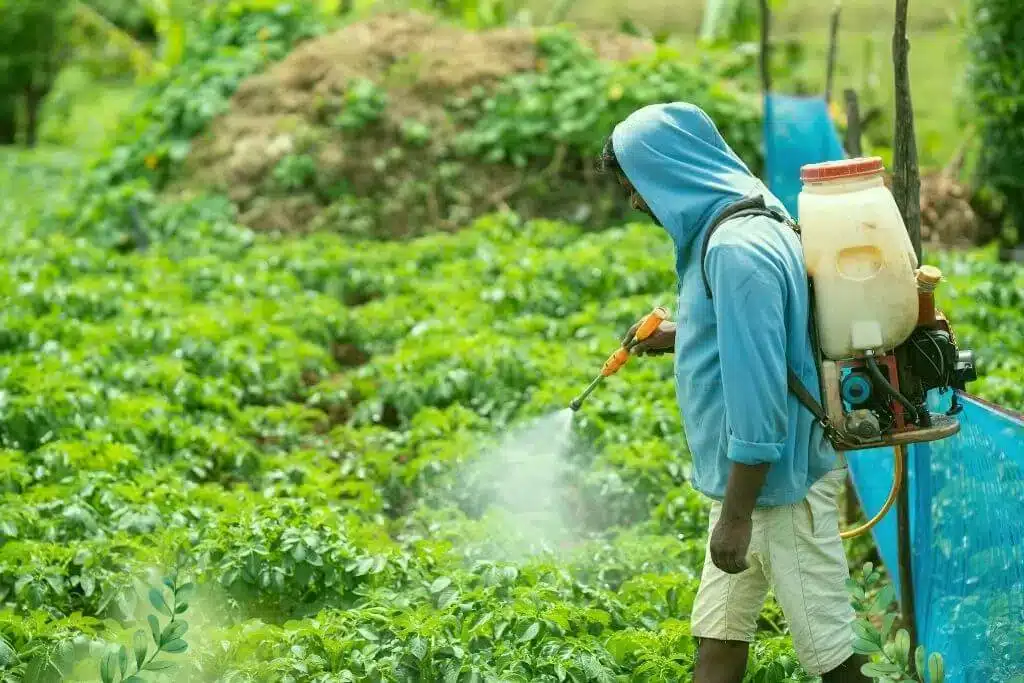
Amino acid fertilizers are used across many crop programmes, but a foliar spray, a drip treatment and a transplant drench each need a different product profile. Matching the grade to the application is as important as the amino acid content.
Foliar feeding during active growth
Foliar application delivers a diluted solution directly to the leaves. It is often used when crops need support during active growth, flowering, fruit setting or the first signs of nutrient stress.
Free amino acid products are commonly used in foliar formulas because they are already in a small, plant-available form. A concentrated powder such as Pepaid™ HA80 can be used as an ingredient in foliar fertilizers or combined NPK and micronutrient formulas.
Apply under mild conditions and avoid strong heat, wind or rain immediately after spraying. Run a small compatibility test before mixing with pesticides, calcium products or concentrated fertilizers.
Fertigation and drip irrigation
Fertigation applies nutrients through irrigation water. Products used in this system need good solubility and low insoluble material to reduce the risk of sediment or blocked emitters.
Liquid amino acid products are easier to meter into an irrigation system. Pepaid™ HA20L is positioned for fertigation, hydroponics and quick foliar use, with at least 18% total amino acids and full solubility in a 5% water solution.
For chloride-sensitive crops or soils where salt is already a concern, chloride level needs closer attention. Pepaid™ HA20-LLC contains at least 22% total amino acids and no more than 1.5% chloride, making it a more suitable starting point for low-chloride liquid formulas.
Root establishment and stress programmes
Transplanting can temporarily slow root activity. Lower-molecular-weight peptides are one option for products designed around root establishment, including the Pepaid™ EA Series. Plant-derived Pepaid™ EP60P is a soybean enzymatic hydrolysate intended for root establishment and flowering-stage programmes.
Stress-management products are most useful as part of a planned programme. If a heat wave, dry period or saline irrigation cycle is expected, time the application before the crop shows serious damage. Combine it with correct irrigation timing, suitable soil moisture, good drainage and careful control of fertilizer salt levels.
After stress, begin recovery applications only once the main cause of damage has been controlled. Start with a conservative rate and observe the crop before increasing the dose.
Good application practice
Crop, growth stage, weather and tank-mix partners all influence the final concentration. Keep records of rate, timing and crop response, and establish performance through representative field trials rather than a single application.
WHUCHEM's Pepaid™ range covers animal- and plant-origin amino acid and peptide grades for foliar, fertigation, transplant and stress-support programmes. Our team can help select a grade and provide specifications and samples for evaluation.
Need a grade or specification?
Send us the product name, CAS number and target application. Our team will confirm the suitable grade and provide TDS, SDS and COA documentation.